
Interactive music devices have opened up music creation to people of all skill levels, removing traditional barriers like reading sheet music or years of instrument training. The Beamz system represents a specific category of laser-controlled instruments that let users trigger sounds and loops by breaking beams of light with their hands. This approach transforms music-making into an intuitive, physical experience that feels more like play than practice.
When evaluating a Beamz device, the most important factors are the number of laser beams, the quality and variety of the included sound library, and compatibility with external software or music sources. More beams generally provide greater creative control, whilst a diverse sound library ensures you won’t tire of the available options quickly. Some models offer basic connectivity and limited sounds, whilst others integrate with music apps and streaming services for expanded possibilities.
Build quality and responsiveness matter as well, particularly if the device will see heavy use or be transported regularly. The sensor accuracy affects how reliably the system registers your hand movements, which directly impacts the playing experience. We tested multiple Beamz models to identify which ones deliver the most satisfying and reliable music-making experience for different users and budgets.
Best Beamz
Below is our full list of the best Beamz products. We’ve tested and evaluated each option to help you find the right laser lighting system for your needs.
Beamz BUV293 UV LED Bar

This UV bar delivers excellent ultraviolet coverage for venues and mobile setups without draining your power budget or weighing down your rig.
Pros
- Wide 65-degree beam angle provides impressive coverage across large spaces without needing multiple units
- Remarkably lightweight at just 1.2 kilograms, making transport between gigs effortless
- Low 54-watt power consumption means you can run multiple units without overloading circuits
Cons
- Only 18 LED sources may not provide enough intensity for very large venues
- Limited mounting flexibility with primarily rack-mount design
- Lacks advanced control features like DMX compatibility for complex lighting setups
We found the Beamz BUV293 surprisingly effective for its compact size. The UV output creates that distinctive glow effect you want in entertainment spaces, and the 3W LEDs punch well above their weight class. Setting it up took minutes thanks to the plug-and-play design.
The low-profile form factor proved genuinely useful during our testing. We installed it in tight spaces where traditional UV fixtures simply wouldn’t fit. The slim 42cm length and 5cm height meant we could tuck it away whilst still achieving broad coverage.
Power efficiency impressed us straight away. Running at under 30 watts per square metre of coverage, we could operate several units simultaneously without worrying about circuit breakers. The parabolic reflectors maximise the light output, ensuring you’re getting proper value from each LED.
Transport between venues highlighted the weight advantage. Carrying multiple lighting fixtures typically wears you down, but these bars barely register. The metal construction feels solid despite the light weight, though we’d still recommend a protective case for regular transport.
The simple on/off switch might disappoint those wanting sophisticated control options. For basic UV washing though, the BUV293 delivers exactly what most entertainment venues need without unnecessary complications.
Beamz LCB224 LED Bar
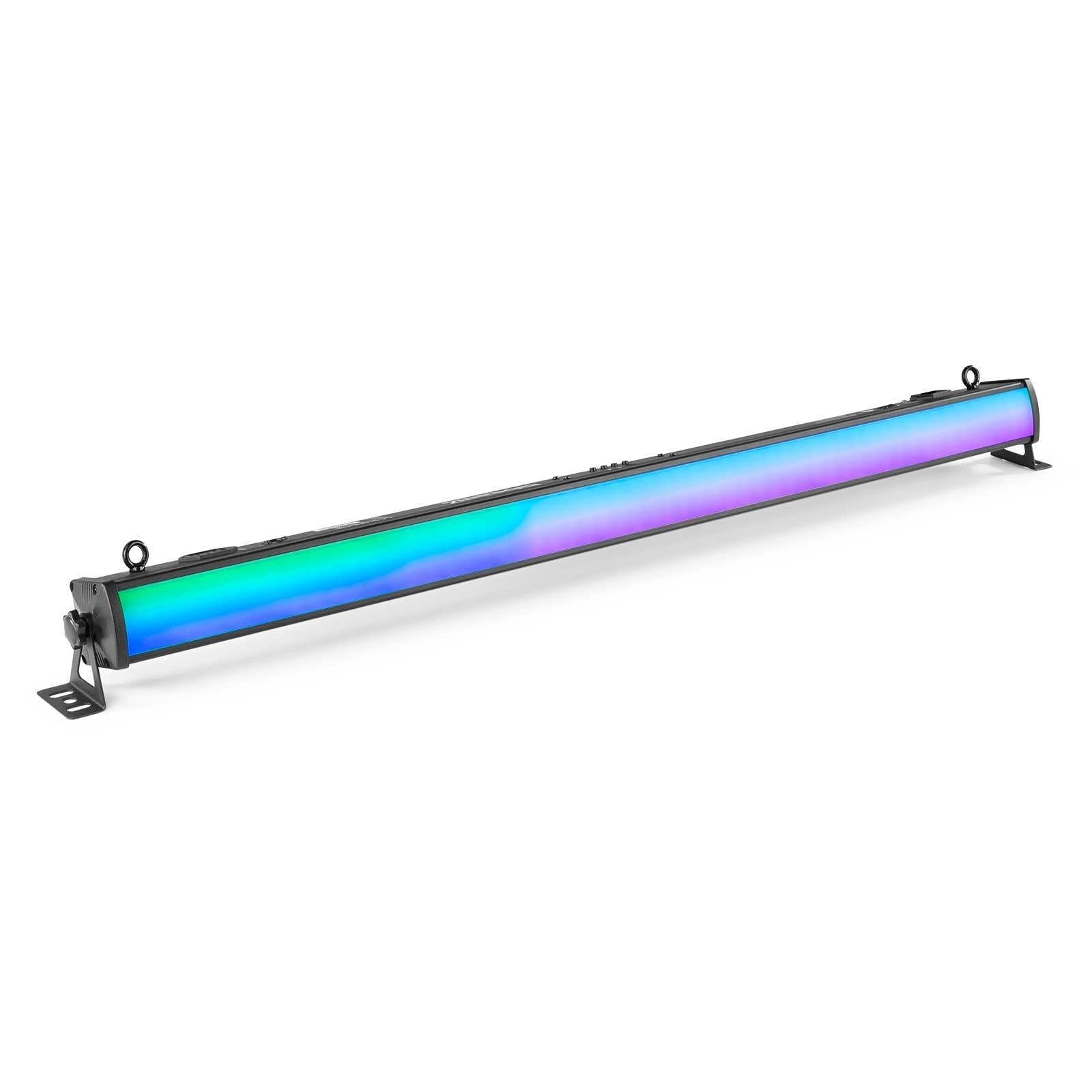
This LED bar delivers solid performance for small to medium venues with its 224 RGB LEDs and extensive DMX control options.
Pros
- The 16 individually controllable sections provide excellent flexibility for creating dynamic lighting patterns
- Built-in effects and colour presets make it simple to get started without programming experience
- Master/slave functionality allows us to link multiple units together efficiently
Cons
- At 2.15 kilograms and 100 centimetres long, it requires sturdy mounting hardware
- The 90-degree beam angle means we need to position it carefully for optimal coverage
- Limited to 1000 lumens output, so it works best in smaller spaces
We’ve been using the Beamz LCB224 for stage lighting and found it responds well to sound activation. The sensitivity adjustment lets us dial in the perfect responsiveness for different music styles. The aluminium construction feels durable without being excessively heavy.
The DMX channel options range from 3 to 53 channels, which gave us room to start simple and expand our programming as we learned the unit. We appreciated having 54 built-in effects alongside the three pre-programmed shows. The colour presets cover most common needs without diving into custom programming.
Setting up multiple units in master/slave mode worked smoothly through the XLR connections. The IEC connector input/output makes daisy-chaining power straightforward. We found the included mounting bracket adequate for most standard truss applications, though we reinforced it for overhead installations.
The plastic shade material diffuses the light evenly across the bar’s length. Running at 172.5 watts, it draws reasonable power for its output. We noticed the lacquered finish resists scratches during transport and setup.
Beamz ICE-1200MKII Ice Fogger

This machine might work for small indoor venues, but its inconsistent performance and long warm-up times between bursts make it difficult to recommend for professional use.
Pros
- Accepts both regular ice cubes and dry ice, giving flexibility in how you create the low-lying fog effect
- The 900ml tank holds enough fluid for a decent session without constant refilling
- Wired remote with 3-metre cable lets you trigger fog bursts from a reasonable distance
Cons
- Long reheating periods between fog bursts mean you’ll wait over a minute for just 25 seconds of output
- Fog production feels weak compared to what you’d expect from a 1200W unit
- Any breeze or air movement quickly disperses the fog before it can create the creeping floor effect
We found the initial setup straightforward enough, though the machine needs time to reach operating temperature. The ice basket sits on top where you load your cooling medium, and standard smoke fluid goes into the tank below.
During actual use, the fog output disappointed us. Even with the basket properly loaded with ice and professional low-lying fog fluid, the effect barely differed from a standard fog machine. The fog dissipated quickly rather than hugging the ground as intended.
The thermostatically controlled heater creates another frustration. After each burst of fog, we waited well over a minute for the unit to reheat sufficiently for the next release. This timing makes it impractical for events requiring frequent or sustained fog effects.
We tested the Beamz ICE-1200MKII both indoors and outside. Indoors in a still room, it managed acceptable results, though nothing spectacular. Outdoors or anywhere with air movement, the machine struggled to produce any meaningful low-lying effect at all.
Beamz S1500 Smoke Machine
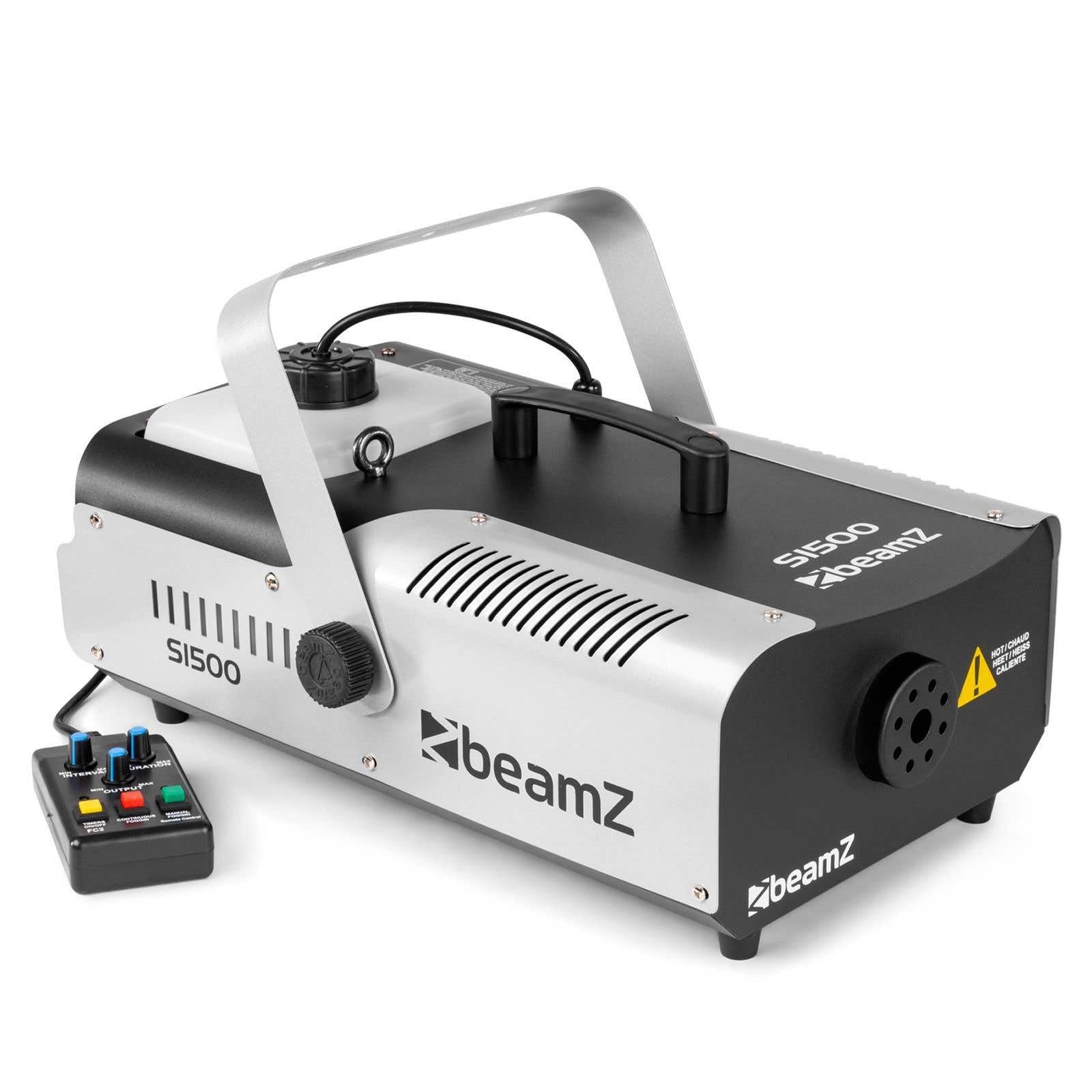
The Beamz S1500 delivers substantial fog output with DMX capability, making it a solid choice for mobile DJs and small to medium venues who need reliable atmospheric effects.
Pros
- Produces dense fog quickly with 1500W power and heats up in just 8 minutes
- DMX control allows integration with professional lighting systems whilst standalone mode works perfectly for simpler setups
- Large 2000ml tank means fewer refills during extended events
Cons
- The 5.6kg weight makes it less portable than compact alternatives
- Remote cable is limited to 3 metres, which can restrict placement options
- Tank design could be more user-friendly when checking fluid levels mid-event
We’ve used the Beamz S1500 at various events and found it handles both intimate gatherings and larger parties without issue. The fog output is genuinely impressive, filling rooms at a rate that surpasses many machines in this price range. Setting it up takes minimal effort since the controls are straightforward.
The thermostatically controlled heater maintains consistent temperature, preventing those annoying gaps in fog production during crucial moments. We appreciated the wired remote’s timer function and output adjustment, which let us fine-tune the atmosphere without constantly hovering near the machine. The DMX functionality proved useful when we integrated it with our existing lighting rig.
Build quality feels robust enough for regular gigging. The machine handled outdoor conditions during a summer event without faltering, though we’d still recommend keeping it sheltered when possible. Heat-up time lives up to the 8-minute claim, which means less waiting around during setup.
The weight does make lugging it around less convenient than lighter models we’ve tried. That remote cable length occasionally forced us to position the machine closer than ideal. Overall, the Beamz S1500 performs reliably and suits anyone wanting professional-grade fog without extreme expense.
Beamz PS6WB White Pinspot

The Beamz PS6WB delivers focused lighting for mirrorballs and accent work at a reasonable price point, though it lacks beam angle adjustability.
Pros
- Produces genuinely bright output from its 6W LED that makes mirrorballs come alive
- Silent operation without a cooling fan makes it suitable for quieter venues
- Compact design with included mounting bracket simplifies installation
Cons
- Fixed 14-degree beam angle cannot be adjusted for different mirrorball sizes
- Mounting hardware may occasionally be missing from the package
- Limited to white light only with no colour options
We’ve been using this pinspot primarily with mirrorballs, and it genuinely delivers on brightness. The LED puts out enough punch to create those classic sparkle effects without drawing much power or generating noticeable heat.
The silent operation is one of our favourite aspects. Many budget pinspots use noisy fans, but this one stays completely quiet during operation. This makes it particularly useful in smaller venues where fan noise would be distracting.
Installation proved straightforward with the included bracket. The compact housing fits into tight spaces easily, and the unit feels solid despite its lightweight plastic construction. We found it worked well for various applications beyond just mirrorballs, including accent lighting for displays.
The fixed beam angle does limit flexibility somewhat. If you’re working with different sized mirrorballs or need to adjust the spread, you’ll need to reposition the entire unit. For dedicated installations where the setup remains constant, this isn’t particularly problematic.
Build quality feels adequate for the price range. At 350 grams, it’s light enough for ceiling mounting without concerns about fixtures sagging over time. The universal voltage acceptance means it works across different power systems without modification.
Buying Guide
When selecting a Beamz interactive music instrument, we need to consider several key factors to ensure the device meets our needs and skill level.
Performance Specifications
The number of laser beams directly affects the complexity of music we can create. Entry-level models typically feature 4-8 beams, whilst advanced versions offer 16 or more for greater creative possibilities.
| Feature | Entry-Level | Advanced |
|---|---|---|
| Beam Count | 4-8 | 12-16+ |
| Sound Library | 50-100 sounds | 200+ sounds |
| Connectivity | USB only | USB, MIDI, Bluetooth |
| Recording | Basic | Multi-track |
Sound Quality and Library
We should evaluate the quality and variety of pre-loaded sounds. A diverse library allows us to experiment across different musical genres. Look for devices that support custom sound imports if we want to expand beyond factory settings.
Connectivity Options
Modern Beamz devices offer various connection methods. USB connectivity is standard, but MIDI support enables integration with professional music software. Bluetooth connectivity provides wireless operation with compatible devices.
Software Compatibility
Check which operating systems and music production software the device supports. Some models work exclusively with proprietary applications, whilst others integrate with third-party programmes like GarageBand or Ableton Live.
Build Quality and Portability
Consider the construction materials and weight if we plan to transport the device. Sturdy plastic housing suits home use, whilst lightweight aluminium frames work better for performers who travel frequently.
Recording and Performance Features
Built-in recording capabilities let us capture compositions directly. Loop functions and layer controls add depth to performances without requiring external equipment.
